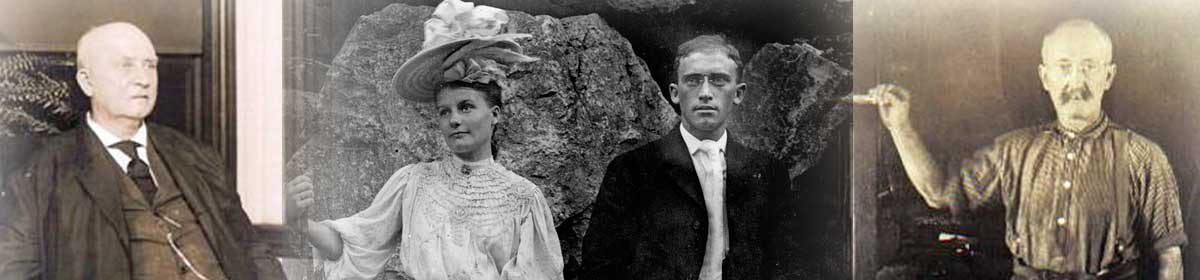
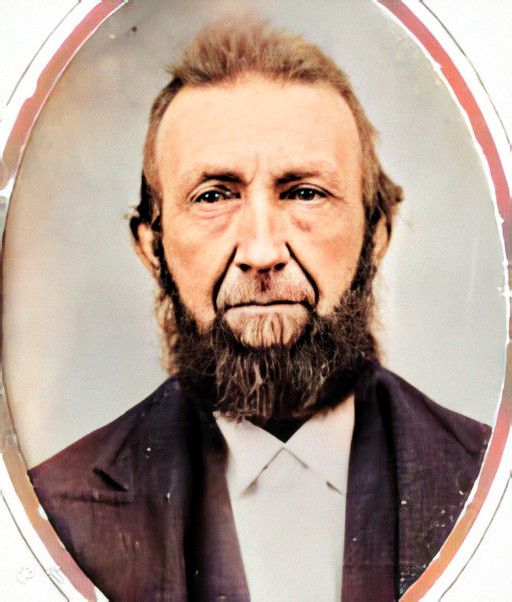
WILLIAM LITTLE (Jr.) was born on November 10, 1828, in Hopewell Township (now Liberty Township), Bedford County, Pennsylvania. He was the third child and second son of William and Mary (Fluck) Little. Not much is known of his childhood except his grandfather Francis Little apparently passed when he was two or three years old. It is believed the young family lived on the land owned by William’s other grandfather, Caspar Fluck, who passed in 1848.
William Jr. struck out on his own to the other side of the Tussey Mountain to Pattonsville, today’s Loysburg. The 1850 US Census shows him residing at the residence of John Foor’s family, he was 21 and occupation “smith”. William soon after met his wife, Nancy Eberly and the couple was married on June 19, 1851.
Notes made by Gaylord W. Little, March 01, 2005:
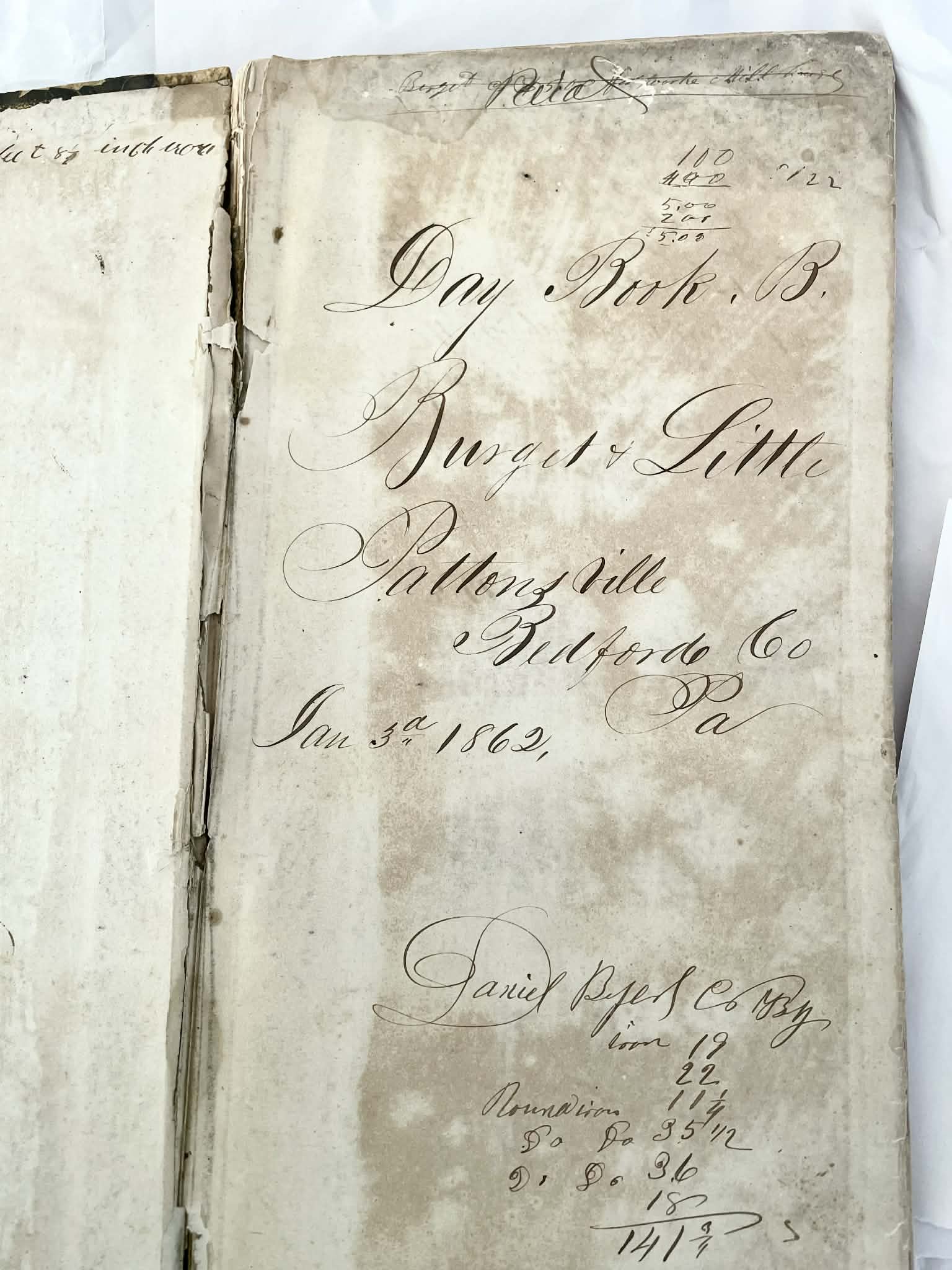
William Little, Jr. came to Pattonsville, Pa. (now known as Loysburg) in 1850. (entry in his handwriting from his blacksmith shop daybook, verbatim), “William Little came to Pattonsville on the 19th day of February a.d. 1850, working for John C. Foor 2 months and on the 22nd of April, the same year, commenced carrying on for himself at Pattonsville 1850”.
The family Bible of William and Nancy, reflects that he was born November 10th, 1828, and that Nancy was born May 27, 1831. They were married June 19, 1851. The entries are in William’s handwriting.
William and Nancy had four children:
i. James Patton Little was born on 16 Apr 1852
ii. Mary Agnes Little was born on 24 Jun 1855 and died April 18, 1925. She married David C. Jamison.
iii. Sarah Catherine Little was born on December 7, 1857. She died on July 9, 1937. She was married to Andrew Jackson Bossler.
iv. Kansas Little was born on December 13, 1859. She died on 09 Nov 1941. “Aunt Kan” was never married.
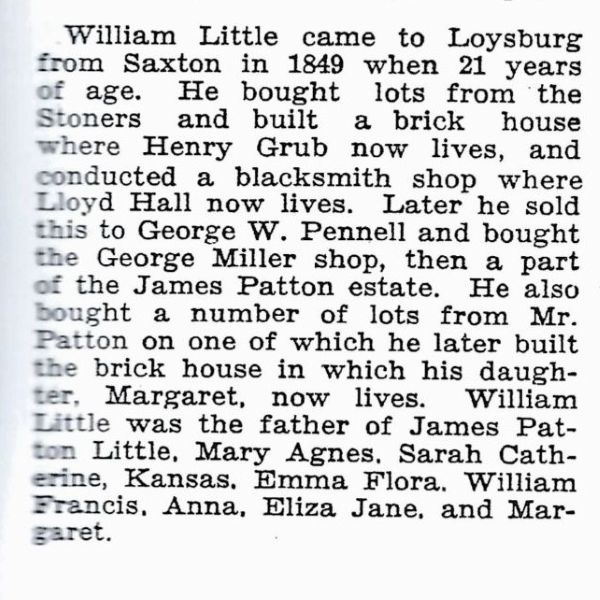
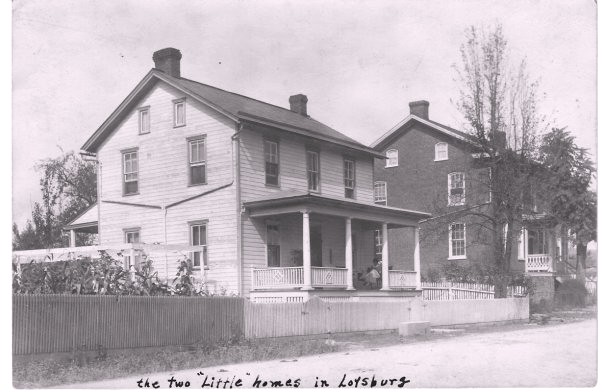
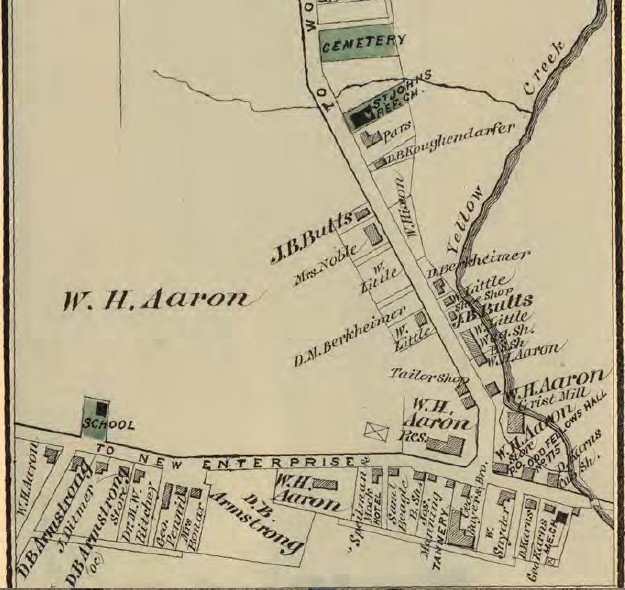
William purchased several lots in Pattonville, as well as the business at the wagon shop. He built at least two houses, more likely three. The large brick home across the road from the shop was where he lived last. When he first came to Pattonsville as a young man of 21, he must have brought an honest reputation and dependable work ethic with him. It’s hard to think he had much financing. The last several properties he purchased, including the wagon and blacksmith shop, were from the estate of Col. James Patton, the gentleman who owned most of the town bearing his name, Pattonville. It was not only the town, but William Little’s first-born son who also bore it: James Patton Little. It speaks of a close relationship between the two men.
Apparently, William was excellent with horses and there are some stories about him evaluating and working with them across the area. James Patton had a racetrack, as did the Snyders up by the large stone house. I am imagining a man such us our ancestor William Little with his knowledge and ability with horses would be good to have in one’s corner.
The Blacksmith and wagon shop was first operated by George Miller about 1830, William and a partner Henry Burget took it over in 1850 or so. Then in 1875, that partnership was “dissolved” and William became the sole owner and proprietor.
Less than a year after Kansas was born in late 1859, her mother, Nancy, passed away. In January 1862, William married again to Catharine, “Kate” Pepple. William and Kate together continued to grow the family with the addition of five more children.
v. Emma Flora Little was born on 28 Feb 1863 but died as a young woman of 16 years of age, May 16, 1879.
vi. William Francis “Frank” Little, PhD. was born on November 24, 1864, and died on April 19, 1939. He married Marou Sophia Brown on July 21, 1910, in Kingston, Massachusetts. Professor Frank had an illustrious career as an educator that deserves his story to be told in a later entry.
vii. Anna Little was born on December 17, 1867. She died in 1946 in Everett, Bedford, Pennsylvania, USA. She married WESLEY A NYCUM. Wesley was a merchant and postmaster for a time in Pattonsville/Loysburg.
viii., ix. Margaret and Eliza Jane Little, twin girls, were born on July 27, 1870. Eliza married Jacob Kagarise. Margaret was never married. Margaret died on June 12, 1946, while Eliza Jane died September 28, 1948. Her husband Jacob passed in May, 1968.
About 1885, William built the white framed house next door to his and across the street from the blacksmith shop. Family lore has it that he built it to lure his son James to come back to town and take over the business. In 1880, his son James is still listed as living in Bloomfield Township, but he moved his young family to the house that his father had built and took over the blacksmith.
James’s youngest daughter, Elsie, lived the last years of her life in that house. After she passed in 1979, James’ great-grandson, Gaylord W. Little acquired the property, raised a lovely family, and lives there still (2026).
William was an active member of the Loysburg Methodist Episcopal Church congregation. According to Rev. C.W. Karns [Historical Sketches of Morrisons Cove; Mirror Press, 1933], “William Little and his wife were among the best people I have ever known and always loyal to the church of their choice.”
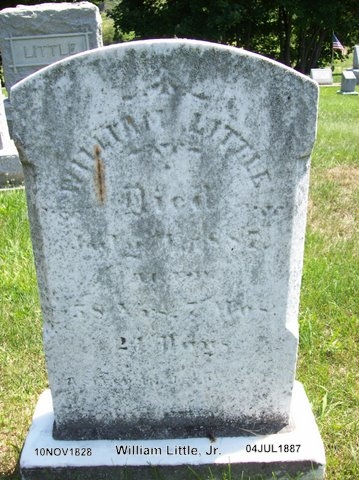
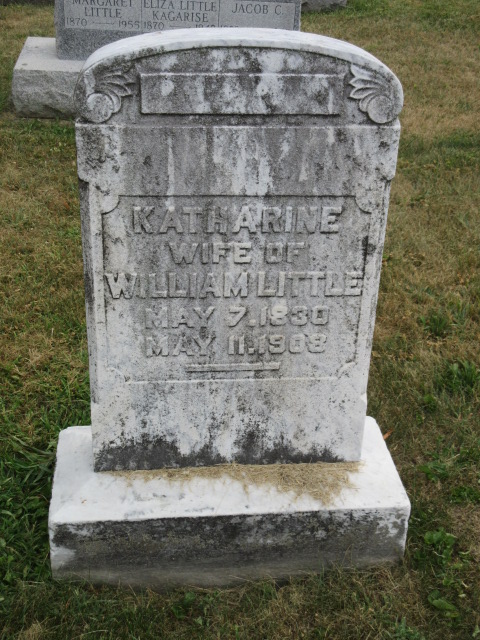
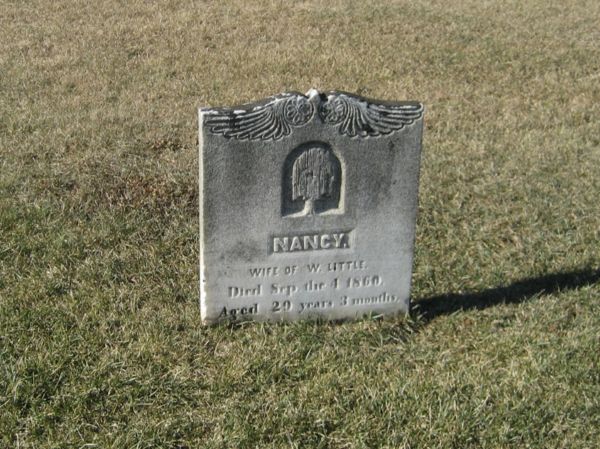
William passed away at his home on the 4th of July, 1887 due to a serious infection. He was only 58 years old. He is buried in the Loysburg Cemetery next to the German Reformed church. Katharine is buried next to him there. Nancy, his first wife is buried up on the hill in the most beautiful spot above town.
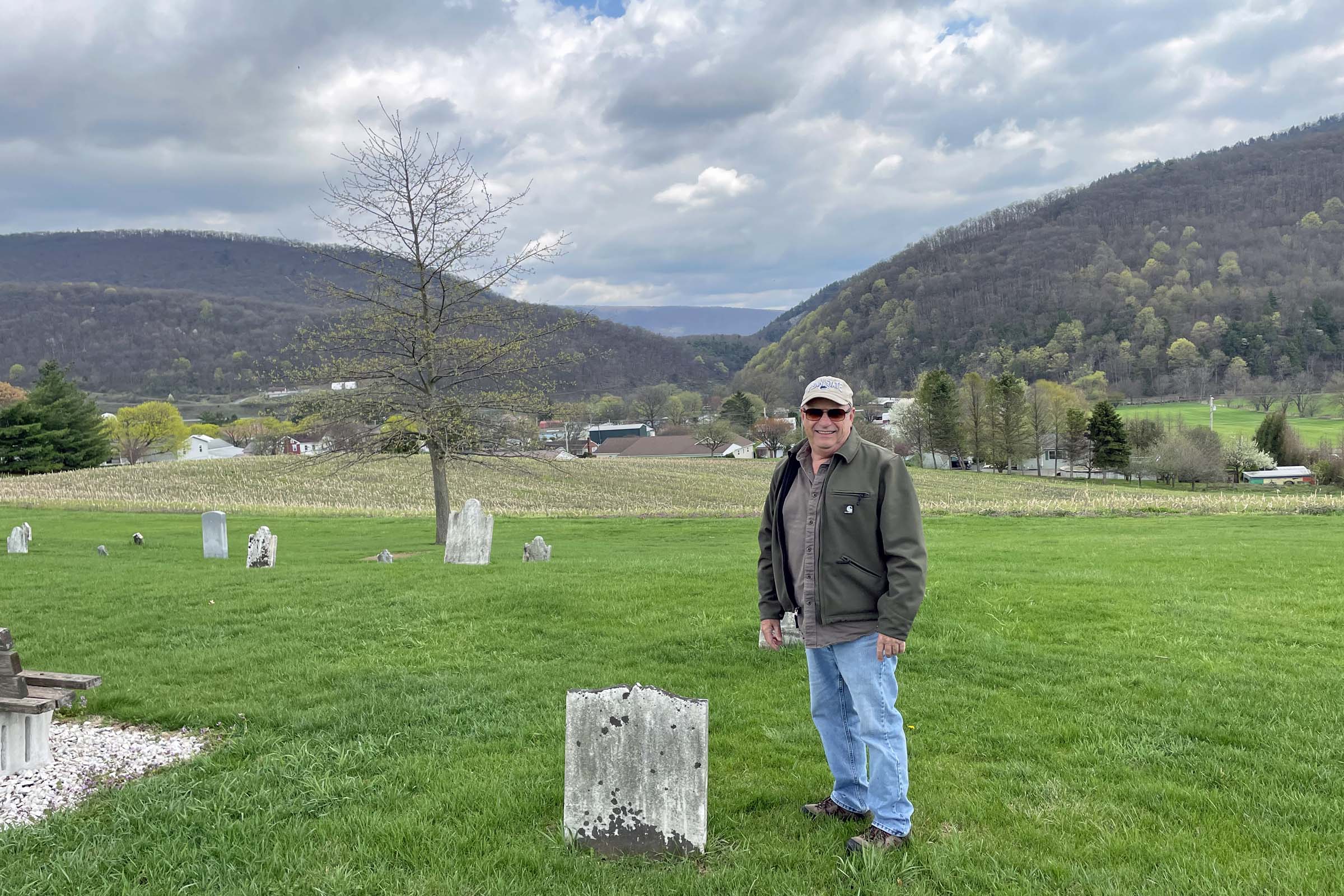
Loysburg – Pattonsville – Loysburg
Post Office was first named “Loysburg” in 1835. The name was changed to “Pattonville” in 1846. Changed back to Loysburg in 1884. The Post Office is now closed with operations combined with Woodbury’s Post Office.
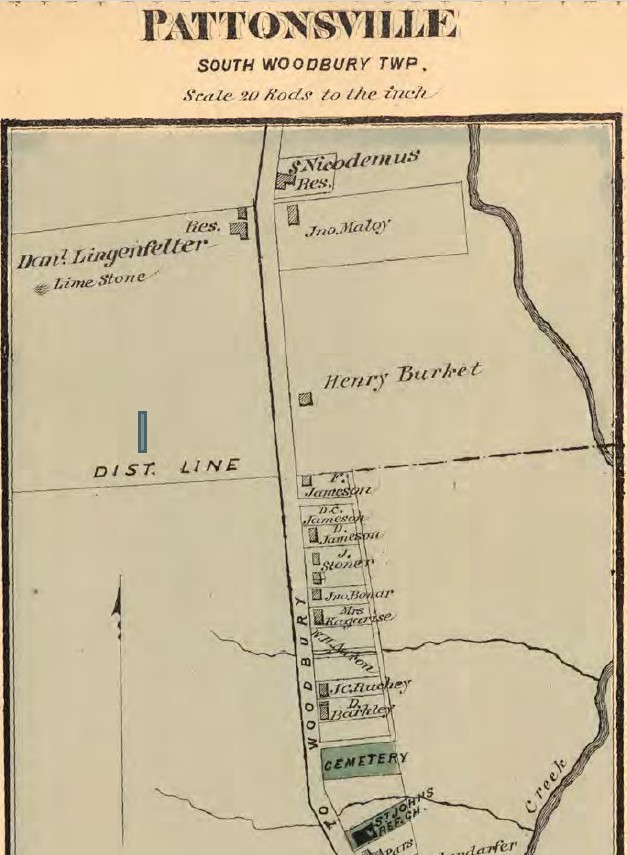
” Loysburg did not begin to grow until the land transaction in connection with the settlement of the David Loy estate in 1844. In that year the trustees for the sale of the David Loy land adjoining the little village to the south sold a section to David Stoner, Sr., a real estate speculator from away. Lots were laid out by Stoner. This is the row of properties on the Methodist Church side of the road today and in old records referred to as the Stoner Addition. Daniel Bare and Andrew Spanogle sold lots along the road from the mill to the present United Church of Christ in the 1860’s. W.H. Aaron extended the sale of lots northward. Thus, although off to a slow start, “Loysburg-Pattonville-Loysburg” began to grow.”1
- -“Bible, Axe, and Plow” Dr. Ben F. VanHorn Dr.Ed. Closson Press 1986 ↩︎
 Squire, Blacksmith, Collier, Settler